
By Kaitlin McHenry
Lavender is well known for its beautiful fragrance. This makes it a beloved perennial plant for both home gardens and a production crop for a wide range of products throughout the world. But why does lavender smell the way it does? Let’s get behind the science of the scent!
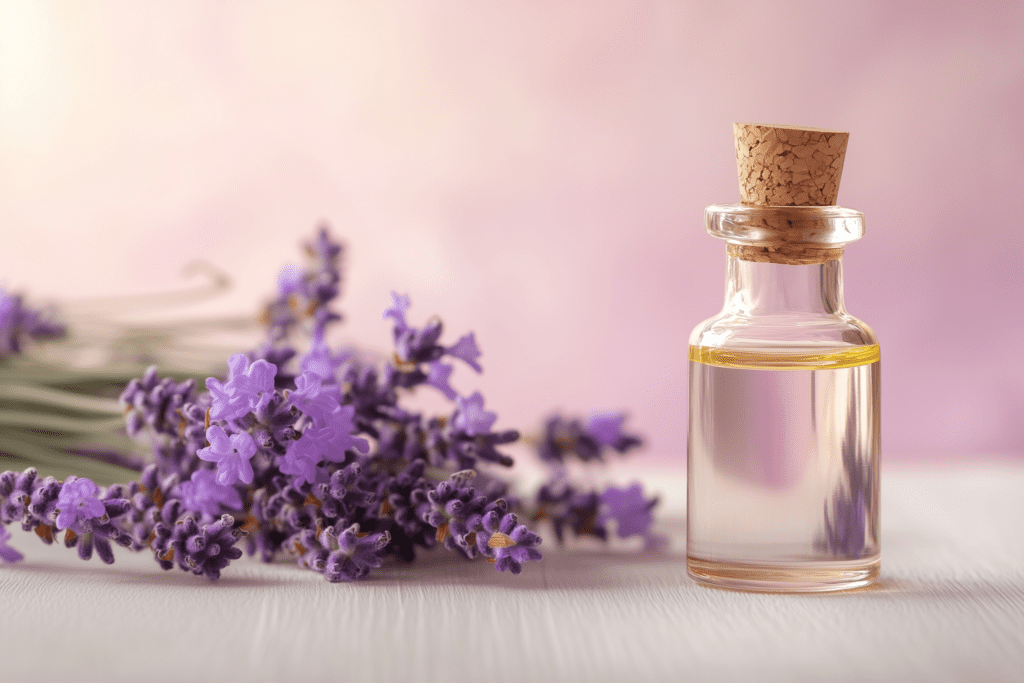
Lavender has a long history with humans as a medicinal herb. It has an even longer history of genetics which contributes to its scent for its own survival.
Lavender has genes which code for aromatic chemical compounds called terpenes. In other words, fragrance is written in lavender’s DNA. There are multiple types of terpenes in lavender, each with different scents and purposes in lavender’s survival. Linalool and linalyl acetate produce a sweet smell that helps lavender attract pollinators. Camphor on the other hand gives the plant a stronger bitterness that deters pests from eating it (Fowler 2022).
In addition to having a sweet scent, linalool also has calming effects when inhaled. It is an excellent stress reliever and pain reducer (Levy 2022). Linalool has anti-inflammatory and antioxidant properties. The calming effect comes from linalool’s ability to trigger brain receptors which release serotonin. Serotonin is a neurotransmitter which contributes to feeling calmness and reduces stress (Simpson 2024).
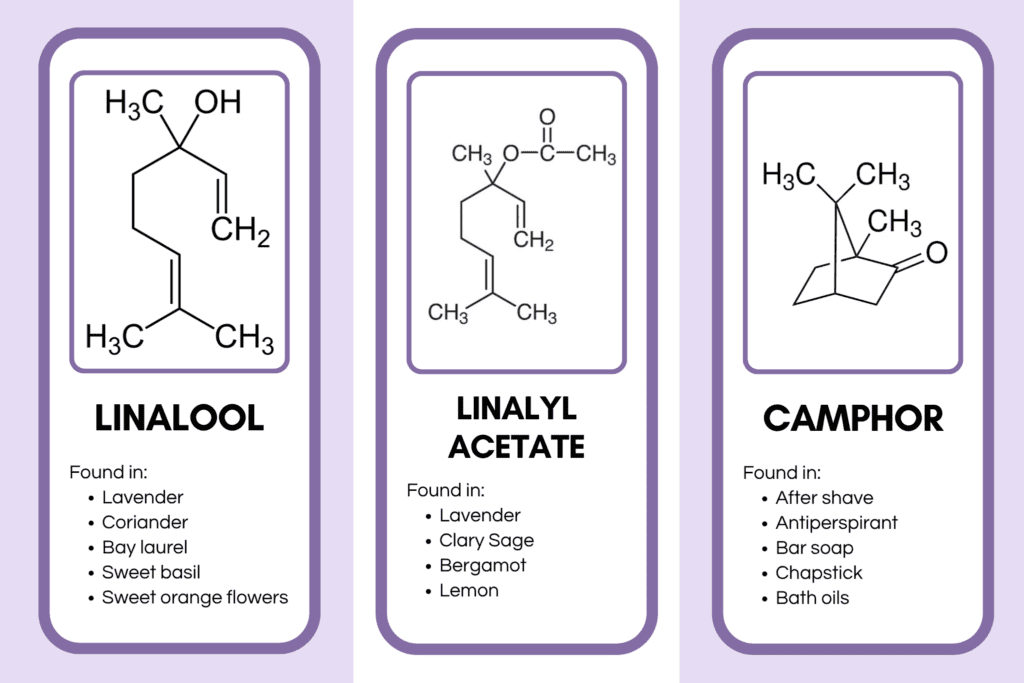
Linalyl acetate is related to linalool with similar properties including being anti-inflammatory (Peana 2002).
Camphor is well known for its antimicrobial and anti-inflammatory properties. It can be used (in small amounts) to heal skin irritations and abrasions and relieve pain. It is not safe to use camphor internally or at all in large concentrations (Cronkleton 2019). Lavender contains safe concentrations of camphor being 1% or less for English Lavender and 8% or less for French hybrid Lavender (Rathore and Kumar 2022). While lavender buds are safe for culinary use, lavender essential oil should not be ingested.
Varying levels in these terpenes give each lavender cultivar its own unique scent. This can be measured through essential oil content. At LHF, we grow 30 cultivars from 2 species of lavender: English Lavender (Lavandula angustifolia) and French hybrid Lavender (Lavandula intermedia).
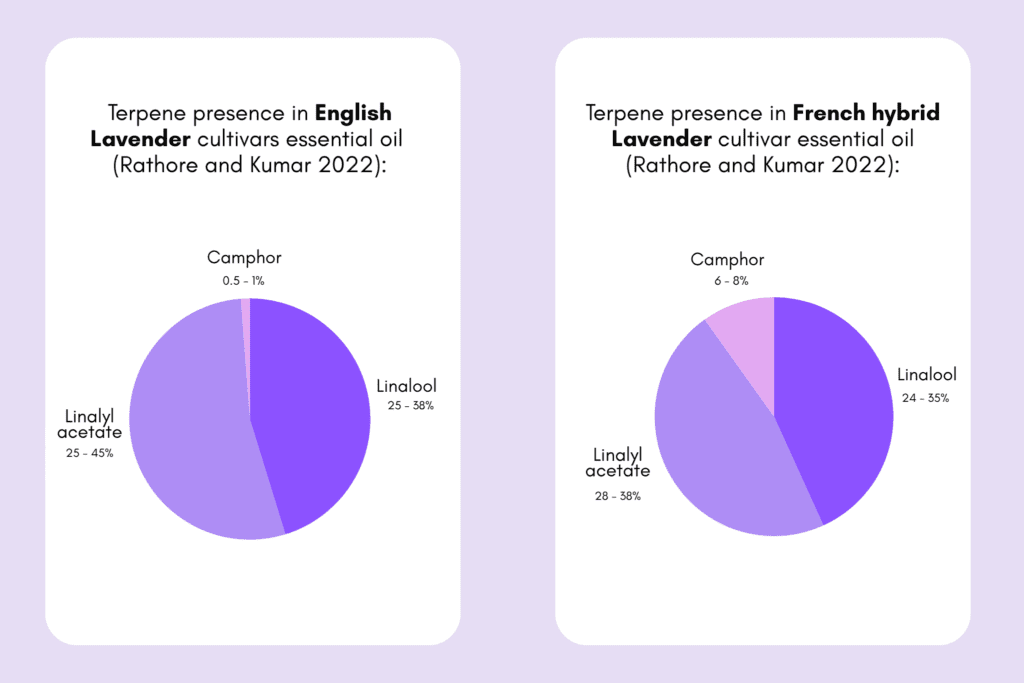
There is a lot of variability in content for each terpene type. The main takeaway between the two species is that French hybrid Lavender has significantly higher camphor content than English Lavender. Camphor is particularly powerful in scent and bitterness. This is why French hybrid Lavender is mostly used in non-culinary products in which more fragrance is desired. This includes candles, lotions, shampoos, bug spray (it’s a great pest deterrent!), and craft lavender in sachets.
The lower camphor content in English Lavender allows for the sweeter terpenes to shine! English lavender is excellent for culinary uses due to its sweeter flavor and scent. While French hybrid Lavender essential oils are more fragrant and have a traditional lavender scent, English Lavender essential oils are uniquely sweet and may be your surprising new favorite scent if you check them out!
Works Cited
Cronkleton, E. (2019, August 8). How to Use Camphor Safely: Benefits and Precautions. Healthline. https://www.healthline.com/health/what-is-camphor#risks
Fowler, M.M. (2022, May 16). Genetics Behind Lavender’s Popular Scent. Science Connected Magazine. https://magazine.scienceconnected.org/2022/05/genetics-behind-lavenders-popular-scent/#:~:text=The%20herb%20owes%20its%20characteristic%20scent%20to%20chemicals,kill%20the%20plant%20and%20keep%20it%20from%20reproducing.
Levy, J. (2022, March 26). What Is Linalool? Benefits, Sources, Side Effects + How to Use It. Dr. Axe. https://draxe.com/health/linalool/
Peana AT;D’Aquila PS;Panin F;Serra G;Pippia P;Moretti MD; (2002, December 9). Anti-inflammatory activity of linalool and linalyl acetate constituents of essential oils. Phytomedicine : international journal of phytotherapy and phytopharmacology. https://pubmed.ncbi.nlm.nih.gov/12587692/
Rathore, S., & Kumar, R. (2022, May 25). Essential oil content and compositional variability of lavandula species cultivated in the mid hill conditions of the Western Himalaya. Molecules (Basel, Switzerland). https://pmc.ncbi.nlm.nih.gov/articles/PMC9182314/#:~:text=The%20lavender%20essential%20oil%20contains,8902%3A2009%20standards%2C%20respectively
Simpson, J. (2024, February 22). Why does Lavender relax you? (the science behind it). Flower Pursuits. https://flowerpursuits.com/why-does-lavender-relax-you/